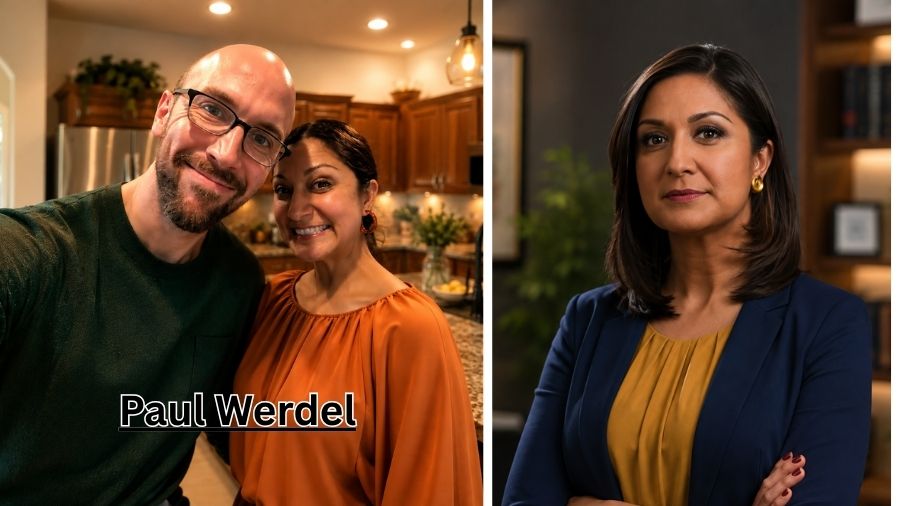
Paul Werdel is an American journalist and news product professional who spent nearly two decades inside major newsrooms before stepping away from a senior role at The New York Times in 2018 to become the primary caregiver for his two daughters. Most readers arrive at his name for one reason: he is Amna Nawaz’s husband, and Nawaz has become one of the most recognisable journalists in the United States since being named co-anchor of the PBS NewsHour. What makes Werdel genuinely interesting, though, is not the marriage alone. It is that he built a serious career at the point where journalism met technology, working at BBC World News, Al Jazeera English, Talking Points Memo and The New York Times, and then chose to set that career aside at its peak. He does not give interviews, does not maintain a public social media presence, and has never sought attention of his own.
Quick Bio
| Detail | Information |
|---|---|
| Full Name | Paul Werdel |
| Known As | Amna Nawaz’s husband; former New York Times editor and product director |
| Profession | Journalist, editor, and digital news product professional |
| Nationality | American |
| Birthplace | Not publicly disclosed |
| Birth Year and Age | Not publicly disclosed |
| Education | Journalism at the University of Maryland, according to his professional profile; not independently confirmed by reporting |
| Spouse | Amna Nawaz, co-anchor of the PBS NewsHour |
| Year of Marriage | 2007 |
| Children | Two daughters, Karam and Lina |
| Known For | Editorial and product roles at The New York Times, plus earlier work at BBC World News, Al Jazeera English and Talking Points Memo |
| Relationship to Amna Nawaz | Husband since 2007 and the couple’s primary caregiver since 2018 |
| Current Residence | Not publicly disclosed |
| Current Status | Married; stepped back from full-time work to raise the couple’s daughters |
| Public Presence | Deliberately minimal, with no interviews or public commentary of his own |
Who Is Paul Werdel?
Paul Werdel is best described as a newsroom insider rather than a public figure, which is precisely why solid information about him is limited and why so much of what circulates online about him is unreliable. He is an American journalist whose career moved from traditional broadcast production into the newer discipline of digital news product management, a field that barely existed when he started out. Credible coverage of his wife has consistently described him in the same way: WWD, profiling Amna Nawaz in late 2022, identified him as a former New York Times product director who left his job to become a stay-at-home parent, and Executive Woman Media, in a July 2023 cover feature, called him a former New York Times product manager who had been instrumental in his wife’s rise. Beyond his professional history and his role in the family, very little about him has ever entered the public record. His date of birth, his age, his hometown, his parents and his current address have never been reported by any reliable outlet. Any website presenting those details with confidence is guessing, and readers should treat such claims with scepticism.
Background in Journalism and Digital Media
Paul Werdel’s professional path tracks almost exactly with the upheaval that reshaped the news business between the mid-2000s and the late 2010s. According to his own professional profile, he studied journalism at the University of Maryland and began in broadcast production, working with BBC World News before joining Al Jazeera English, where he served as a deputy news editor and later a news editor during the network’s early years of building an American audience. He then moved to Talking Points Memo, one of the first genuinely web-native political news operations in the United States, a place where editorial judgment and the mechanics of online publishing were inseparable. That combination made him a natural fit for The New York Times, which he joined in the early 2010s as the paper was rebuilding itself around mobile readers and paid digital subscriptions. There he held a progression of roles that bridged the newsroom and the product organisation, including editing work on digital platforms and senior product responsibility for mobile experiences. It is worth noting that this career chronology comes largely from his own professional listings rather than from independent reporting, so the exact titles and dates should be treated as his account rather than as verified fact.
Marriage and Relationship With Amna Nawaz
Paul Werdel and Amna Nawaz married in 2007, a detail confirmed on Nawaz’s Wikipedia entry and consistent across the reporting that mentions him. At the time, both were early in careers that would take them through some of the most demanding newsrooms in the world; Nawaz had joined Dateline NBC’s investigative unit in 2003 and would go on to serve as NBC’s Islamabad bureau chief before moving to ABC News and then to PBS in 2018. Almost nothing about how the couple met, where they married or how they conducted their early life together has ever been publicly shared, and neither of them has invited that kind of coverage. What Nawaz has spoken about, repeatedly and warmly, is what the partnership has meant to her professionally. In her Executive Woman Media feature she described her husband’s decision to take over at home as the greatest gift he had given her, and made clear it was his idea rather than the outcome of a difficult negotiation. That single anecdote reveals more about the relationship than years of speculation ever could, and it is one of the few first-hand glimpses of Paul Werdel that exists in print.
Parenthood and Family Life
Paul Werdel and Amna Nawaz have two daughters, Karam and Lina, whose names appeared in WWD’s 2022 profile of Nawaz, which listed them as nine and seven years old at the time of publication. Beyond first names and those approximate ages, the couple has kept their children almost entirely out of public view, occasionally referencing them in general terms without photographs, schools or specifics, which is a deliberate and increasingly common choice among journalists with national profiles. Since 2018, Werdel has been the parent handling the daily architecture of family life, the school runs and the appointments and the countless small logistics that a nightly news anchor’s schedule cannot absorb. Nawaz has framed that arrangement as more than a practical solution, describing it as something she believes is genuinely valuable for their daughters to witness, because it shows them that a household can be organised in many different ways and that caregiving is not automatically the mother’s job. That framing has resonated widely, and it is a large part of why readers searching for Amna Nawaz’s husband find a story that feels different from the usual celebrity-spouse profile.
Supporting Amna Nawaz Through the Aftermath of Uvalde
Paul Werdel’s most consequential documented contribution to his wife’s life may have had nothing to do with logistics at all. In the Executive Woman Media feature, Nawaz spoke candidly about the psychological toll of covering catastrophe, and identified the 2022 school shooting in Uvalde, Texas, as her turning point. She explained that for most of her career she had not acknowledged the effect of such assignments, because newsroom culture treated moving on as the only acceptable response. After Uvalde, she did not initially recognise how much distress she was carrying or how badly it had aggravated a lifelong struggle with anxiety. It was her husband who noticed, raised it gently, told her plainly that she was not all right, and encouraged her to find a therapist. Nawaz has since become an outspoken advocate for mental health support among journalists, regularly checking in with younger colleagues at PBS and speaking openly about how therapy helped her process what she had witnessed. That advocacy, which has reached a great many people in the profession, traces back in part to one quiet conversation at home.
Life After Leaving The New York Times
Paul Werdel’s departure from The New York Times in 2018 coincided with Amna Nawaz joining PBS, and the timing was not accidental. Nawaz’s account is that he approached her with the idea, proposing they try the arrangement for a few years so that she could give the new role everything she had without managing childcare handovers or racing to catch a train. In an industry where stepping away for even a year can quietly close doors, giving up a senior product position at the most influential newspaper in the country was a substantial professional risk, and one that men in his position rarely take. The years that followed were the years in which Nawaz’s career accelerated sharply, from correspondent and substitute anchor to being named co-anchor of the PBS NewsHour in January 2023 alongside Geoff Bennett, becoming the first Asian American and first Muslim American to anchor a nationally broadcast news programme. Whether Werdel has taken on freelance or consulting work in the period since has not been confirmed by any credible source, and claims elsewhere about his current employment or income should not be trusted.
Career Highlights and Public Recognition
Paul Werdel’s career highlights are the kind that rarely produce awards or applause, because product work sits behind the journalism rather than on top of it. His most substantial documented contribution is his New York Times tenure during a period when the paper was learning how to reach readers who had moved to phones, an era in which decisions about mobile layouts, home screens and news alerts shaped whether serious journalism actually reached anyone. He did retain a reporter’s instincts throughout: Muck Rack’s index of his bylines shows him writing for the Times during the 2014 World Cup, filing match reports on group-stage results, which is a reminder that his editorial background never fully switched off. Public recognition, in the conventional sense, has largely passed him by, and by every indication that suits him. He has no verified public commentary, no bylined essays about his career change, and no interviews explaining his decision. The recognition he has received has come almost entirely second hand, through his wife’s willingness to name him as a central reason for her own success.
Why People Search for Paul Werdel
Paul Werdel’s search traffic rises and falls with his wife’s visibility, and it climbed steeply after January 2023 when Nawaz took the PBS NewsHour anchor chair and became a nightly presence in millions of American homes. Viewers who admire her want to understand the life behind the broadcast, and the discovery that her husband left a prestigious job to run the household turns an ordinary curiosity into a story people want to read. There is a second reason, though, and it is less flattering to the internet. Because so little verified information about Werdel exists, dozens of low-quality websites have filled the vacuum with fabricated biographies, complete with invented birthdays, imagined net worth figures, fictional physical descriptions and confidently stated details that no reporter has ever confirmed. Those articles rank well precisely because genuine sources are scarce, which means anyone searching his name encounters far more invention than fact. Understanding that dynamic matters as much as any biographical detail, because it explains why two websites about the same man can contradict each other completely.
Privacy, Accuracy and Public Information
Paul Werdel occupies an unusual position, publicly connected to a national broadcaster while being, by any reasonable definition, a private individual who has never sought or accepted a public role. That distinction should shape how anyone writes about him. The responsible boundary is what credible journalism has actually reported, which amounts to his professional history, his marriage in 2007, his two daughters, and his decision in 2018 to become the primary caregiver, along with the account his wife has chosen to share about the support he provided during a difficult period. Everything past that line is either self-reported career information from his own professional profile, which is plausible but unverified, or outright invention. Readers encountering specific claims about his age, his birthplace, his religion, his height, his net worth or his current address should recognise that no reliable outlet has published any of it. Accuracy here is not merely a technical standard; it is a matter of basic fairness to a man whose only real connection to public life is that he married someone who became famous.
Conclusion
Paul Werdel’s story is a small but genuinely meaningful counterweight to the usual narrative about ambition and success in high-pressure professions. He built a career that spanned traditional broadcast newsrooms and the digital transformation that upended them, ending up in a senior role at The New York Times during one of the most consequential periods in that institution’s history, and then made a decision that most people in his position would not make. The record shows he made it willingly, proposed it himself, and never sought credit for it. Amna Nawaz’s ascent to the PBS NewsHour anchor desk, and her later advocacy for the mental health of journalists, both have his quiet involvement somewhere in the background. Anyone searching for Amna Nawaz’s husband hoping for scandal, wealth figures or personal revelations will be disappointed, and that is entirely to his credit. What remains is a straightforward and rather admirable account of a person who decided that being present at home was worth more than the title he gave up, and who has never once asked to be praised for it.
Also read: Emily Threlkeld: From Luxury Fashion PR to Harold Ford Jr.’s Wife
FAQs
Who is Paul Werdel?
Paul Werdel is an American journalist and former New York Times editor and product director, best known publicly as the husband of PBS NewsHour co-anchor Amna Nawaz since 2007.
When did Paul Werdel and Amna Nawaz get married?
The couple married in 2007, well before Nawaz became a national anchor. Details about how they met and where they married have never been publicly disclosed by either of them.
Why did Paul Werdel leave The New York Times?
He left in 2018, the year Amna Nawaz joined PBS, to become the primary caregiver for their two daughters. Nawaz has said the arrangement was entirely his idea.
How many children do Paul Werdel and Amna Nawaz have?
They have two daughters, Karam and Lina. WWD reported their ages as nine and seven in late 2022. The couple keeps their children largely out of public view.
What is Paul Werdel’s age and date of birth?
Neither has ever been reported by a reliable source. Websites listing a specific birthday or age for Paul Werdel are presenting unverified information that no credible outlet has confirmed.
Where did Paul Werdel work before The New York Times?
According to his professional profile, he worked with BBC World News, then Al Jazeera English as a news editor, and Talking Points Memo, though independent reporting has not confirmed these roles.